






Quartz vs Granite Countertops: Which Is Better for Indian Kitchens
When designing or renovating an Indian kitchen, the countertop is one of the most critical decisions you’ll make. From heavy tadka cooking and hot utensils to oil spills and daily wear, Indian kitchens demand a surface that is durable, hygienic, stylish, and cost-effective. This is where the debate of quartz vs granite comes in.
Both quartz and granite are premium countertop materials, but they differ significantly in composition, maintenance, appearance, and performance. In this detailed guide, we compare quartz vs granite countertops across all important parameters to help you choose the best option for Indian kitchens.
Understanding the Basics: Quartz vs Granite
What Is Quartz?
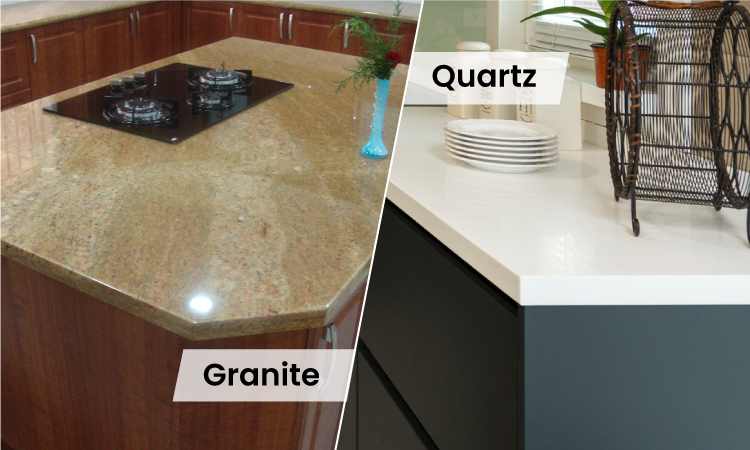
Quartz countertops are engineered stones made from around 90–95% natural quartz crystals, combined with resins, polymers, and pigments. This manufacturing process allows quartz to offer consistent colors, smooth finishes, and excellent durability.
What Is Granite?
Granite is a 100% natural stone, formed deep within the earth over millions of years. It is quarried in large blocks, cut into slabs, and polished. Each granite slab is unique, with natural veins, swirls, and mineral patterns.
Also Read: Types of Granite
Appearance & Design: Quartz vs Granite
Quartz Appearance
- Uniform color and pattern
- Available in a wide range of shades
- Can mimic marble or natural stone
- Ideal for modern and modular kitchens
Granite Appearance
- Natural patterns and veining
- Earthy, organic look
- No two slabs look the same
- Perfect for traditional and luxury kitchens
Verdict:
Choose quartz for a clean, contemporary look. Choose granite if you value natural beauty and uniqueness.
Durability & Strength in Indian Kitchens
Quartz Durability
- Non-porous and scratch-resistant
- Resistant to stains from oil, turmeric, and spices
- Strong but sensitive to extreme heat
Granite Durability
- Extremely hard and heat-resistant
- Can handle hot utensils directly
- Porous by nature and may stain if not sealed properly
Verdict:
Granite performs better with heat. Quartz performs better with stains and daily wear.
Maintenance & Hygiene Comparison
Quartz Maintenance
- No sealing required
- Easy cleaning with mild soap and water
- Highly hygienic and bacteria-resistant
Granite Maintenance
- Requires sealing at installation and periodically
- Needs more care to prevent stains
- Can absorb liquids if seal wears off
Verdict:
For low-maintenance Indian kitchens, quartz wins clearly.
Heat Resistance: Quartz vs Granite
- Granite withstands high temperatures better and is safer for direct hot pots.
- Quartz contains resins that may discolor or crack under extreme heat.
Tip: Always use heat pads with quartz countertops.
Cost Comparison in India
|
Material |
Average Price (₹/sq ft) |
|
Granite |
₹100 – ₹130 |
|
Quartz |
₹120 – ₹150 |
While granite has a lower initial cost, quartz saves money long-term due to minimal maintenance.
Environmental Impact
Quartz
- Manufactured locally
- Some brands use recycled materials
- Uses chemical resins
Granite
- Requires quarrying and transportation
- 100% natural and recyclable
- No synthetic materials
Verdict:
Both have pros and cons; sustainability depends on sourcing.
Stain & Scratch Resistance
- Quartz is non-porous, making it more stain-resistant.
- Granite resists scratches well but can stain if unsealed.
- Quartz may scratch under sharp objects but performs well overall.
Uniqueness vs Consistency
- Granite offers one-of-a-kind natural beauty
- Quartz offers predictable and consistent finishes
Choose based on whether you value uniqueness or uniformity.
Which Is Better for Indian Kitchens?
Choosing between quartz and granite for an Indian kitchen depends largely on your cooking style, maintenance preference, and design taste. Indian kitchens experience heavy daily use, frequent spills of oil and spices, and exposure to heat, so the countertop material must be both practical and durable.
Choose Quartz If:
Quartz is an excellent choice if you are looking for a low-maintenance and hygienic kitchen surface. Since quartz is a non-porous engineered stone, it does not absorb oil, turmeric, masala, or liquids—making it ideal for Indian cooking. Cleaning is simple and does not require sealing, which is perfect for households that want convenience without compromising on looks.
If hygiene is a top priority in your home, quartz stands out because it does not allow bacteria or moisture to seep into the surface. This makes it safer for food preparation, especially in kitchens that are used multiple times a day. Quartz is also well-suited for homeowners who prefer modern, sleek, and uniform designs, as it is available in a wide range of colors and patterns with consistent finishes.
For busy families or working professionals whose kitchens see heavy daily use, quartz offers long-term durability with minimal effort. Its resistance to stains and scratches makes it a stress-free option for everyday cooking.
Choose Granite If:
Granite is the right choice if you appreciate the natural beauty and uniqueness of stone. Every granite slab has its own natural patterns, veins, and textures, giving your kitchen a one-of-a-kind appearance. If you value character and organic design, granite offers a timeless appeal that never goes out of style.
Heat resistance is another major advantage of granite, making it ideal for Indian kitchens where hot utensils, pressure cookers, and tavas are commonly used. You can place hot pots directly on granite without worrying about damage, which adds to its practicality.
Granite is perfect for homeowners who don’t mind periodic sealing and regular maintenance. When properly sealed, granite remains durable and long-lasting for decades. It also complements traditional, classic, and luxury kitchen designs, making it a preferred choice for those who want a rich and elegant kitchen aesthetic.
Conclusion: Quartz vs Granite – Final Verdict
There is no one-size-fits-all answer in the quartz vs granite debate. For modern Indian kitchens where ease of cleaning, hygiene, and stain resistance matter most, quartz countertops are the better choice. However, if you value natural beauty, heat resistance, and timeless appeal, granite remains unmatched.
At A-Class Marble, you can explore premium quartz and granite countertop options that suit Indian kitchens perfectly—combining durability, style, and long-term value.
FAQs: Quartz vs Granite Countertops for Indian Kitchens
1. Which is better for Indian kitchens – quartz or granite?
Both quartz and granite work well in Indian kitchens, but the better option depends on your cooking habits. Quartz is ideal for homes with heavy daily cooking because it is non-porous, stain-resistant, and easy to clean. Granite, on the other hand, is better suited for households that frequently use hot cookware, as it has superior heat resistance. If low maintenance is your priority, quartz is the better choice; if natural beauty and heat tolerance matter more, granite is ideal.
2. Does quartz stain easily with turmeric, oil, or spices?
No, quartz countertops do not stain easily. Since quartz is a non-porous engineered stone, it does not absorb oil, turmeric, coffee, or masala stains. Even in Indian kitchens where spices are used daily, quartz maintains its appearance with simple cleaning using mild soap and water, making it a highly practical option.
3. Does granite require regular sealing and maintenance?
Yes, granite is a natural porous stone and needs sealing at the time of installation and periodically afterward. Sealing helps prevent the absorption of oil, water, and food stains. In Indian kitchens, where spills are frequent, proper sealing is essential to maintain hygiene and longevity. With regular care, granite countertops can last for decades.
4. Is quartz more expensive than granite in India?
Quartz countertops generally have a slightly higher initial cost compared to granite. However, quartz does not require sealing or special maintenance, which reduces long-term expenses. Granite may appear more affordable at first, but periodic sealing and maintenance can increase its lifetime cost. Overall, quartz offers better value for homeowners seeking low upkeep.
5. Can hot pans and utensils be placed directly on quartz countertops?
It is not recommended to place extremely hot pans directly on quartz countertops. Quartz contains resins that may get damaged or discolored due to excessive heat. Always use trivets or heat pads to protect the surface. Granite performs better in this area and can handle high temperatures more effectively.
6. Which countertop material lasts longer – quartz or granite?
Both quartz and granite are highly durable and can last for several decades when properly maintained. Quartz offers consistent performance with minimal care, while granite’s longevity depends on proper sealing and maintenance. Neither material wears out easily, making both excellent long-term investments for Indian homes.
7. Is granite suitable for modern modular kitchens?
Yes, granite can be used in modular kitchens, especially if you prefer a natural and luxurious look. However, due to its natural patterns, color consistency can vary between slabs. Granite also requires more maintenance compared to quartz, which is why many modern modular kitchens now prefer quartz for its uniform appearance and easy upkeep.
8. Which material offers better design options – quartz or granite?
Quartz offers more design flexibility because it is engineered and available in a wide range of colors, patterns, and finishes. It can mimic marble, concrete, or natural stone looks. Granite, while beautiful, is limited to naturally occurring patterns and colors. If customization and color consistency are important, quartz is the better option.
9. Is quartz more hygienic than granite for kitchen use?
Yes, quartz is more hygienic because it is non-porous and does not allow bacteria, moisture, or food particles to penetrate the surface. Granite, if not sealed properly, can absorb liquids and harbor bacteria. For families focused on hygiene and easy cleaning, quartz countertops are a safer choice.
10. Which countertop material adds more value to a home?
Both quartz and granite enhance the overall value of a home. Granite appeals to buyers who appreciate natural stone and timeless design, while quartz attracts modern homeowners looking for sleek finishes and low maintenance. Choosing either material from a premium supplier like A-Class Marble can significantly boost your kitchen’s aesthetic and resale value.


Sitemap
- Newsletter
- Catalouge
- Gallery
- Legal & Privacy
- Career
- Share
- Media
- News & Events
- Press Coverage
- Blogs
- Awards
- Signature
- Bianco Snow White
- Bronze Amani
- Afyon White
- Jasper Gold
- Kilimanjaro white
- Mexican Gold
- Statuario
- Pristine
- Pink Michel Angelo
- Ariston white
- Bianco Covelano
- WHITE CHIANTE
- Carrara white
- Lilac White
- Blue o Bisuai
- Classique
- Royal Crema
- SARDANIYA BEIGE
- Perlato Royal
- Extra Light
- Imperial Beige
- Light Emperador
- De Martino
- Virtual Applicator
- Kitchen
- Bathroom
- Bedroom
- Clientele
- Clients
- Testimonial
- Melange
- Sequia Brown
- Amazing silver
- Pisato
- Enigma
- Metal Rust
- Moroccan Black
- Nsl Black
- Umber
- BEIGE TRAVERTINO
- TITANIUM TRAVERTINO
- SILVER TRAVERTINO
- Exotica
- Azul Pink
- Azul Macaubas
- Azul Skyline
- Opera
- Zade Green onyx
- zebra onyx
- Sunrise Onyx
- Bejewel
- Smokey Quartz
- Rose Quartz
- Red Agate
- Avant Garde
- maxican wave
- Matrix hydro finish
- Bianco Moon Face
